Overview

From Empirical to Evidence-Based: Accelerating Sepsis Decisions & Strengthening Infection Control

Precision medicine is the shared ambition of global healthcare. Yet, while therapeutics evolve rapidly, clinical diagnostics remain structurally disconnected due to biological and operational constraints. In sepsis and critical infection care, traditional AST (Antimicrobial Susceptibility Testing) still requires 24–72 hours—lagging significantly behind disease progression.
 
This prolonged "Diagnostic Blind Spot" forces clinicians to rely on Empirical Therapy during the golden window of survival. This systemic failure not only misallocates medical resources but also fuels the structural root of the global Antimicrobial Resistance (AMR) crisis, through prolonged empirical therapy and delayed treatment optimization.

To bridge this gap, Playsure, in strategic collaboration with National Cheng Kung University (NCKU) and Chi Mei Medical Center, acts as a catalyst for "Translational Engineering," advancing engineering approaches that connect research-grade precision with clinical application.
We go beyond hardware integration, focusing on translating academic innovation into system-level capabilities aligned with clinical workflows. By integrating advanced optical detection with algorithmic interpretation, we compress the AST cycle from 24–72 hours to just 2–4 hours—a 90% reduction that transforms clinical response. This eliminates the diagnostic vacuum, driving a paradigm shift from empirical guesswork to evidence-based precision within the same clinical shift.

#PrecisionMedicine #AlgorithmicEngineering #SystemArchitectureDesign #RapidASTTesting #RapidSepsisDiagnostics #AntimicrobialStewardshipProgram

The Structural Paradox

The Structural Tensions Shaping Diagnostic Practice

Three core misalignments define the current diagnostic landscape:

Biological Time vs. Clinical Urgency

Bacterial culturing operates on biological growth cycles measured in days. Clinical decision-making in acute sepsis operates in hours. This temporal mismatch is not a matter of effort or cost—it reflects a fundamental incompatibility between biological process duration and clinical need. No amount of process optimization can compress bacterial division rates.

Precision Architecture vs. Production Scale

Microfluidic optical detection technologies can capture micrometer-scale dynamics with high fidelity. However, scaling to clinical volumes introduces a second paradox: traditional approaches to increasing throughput require linear increases in instrument footprint or precision engineering complexity. In space-constrained clinical settings, this scaling approach becomes economically and operationally unfeasible. The challenge is not "how to make machines faster," but "how to maintain precision while enabling true multiplexing within physical constraints."

Tacit Expertise vs. Operational Standardization

Laboratory diagnostics traditionally depend on domain expertise—the accumulated intuition and skill of experienced technicians. Yet frontline clinical laboratory staff operate in high-stakes, high-pressure environments with minimal error tolerance. Advancing diagnostic capability requires translating complex biochemical procedures into low-cognitive-load, error-resistant workflows. Until expertise can be systematically encoded, even breakthrough technologies struggle to clear regulatory pathways and achieve clinical adoption.

System Re-engineering

Re-architecting Base Logic via Algorithmic Engineering:
Bridging the Structural Divide between Physical Constraints and Clinical Operations

In response to these structural paradoxes, Playsure—in partnership with elite clinical teams from National Cheng Kung University (NCKU) and Chi Mei Medical Center—executed a comprehensive "Base Architecture Restructuring" strategy. Together, we translated foundational biomedical principles into system-level solutions designed for clinical environments that align with existing laboratory workflows by deploying dual core technologies—Algorithmic Engineering and Asynchronous System Control—that successfully addressed the dual complexities of physical hardware limits and clinical workflows.

Engineering Micro-signals and System Integration

Utilizing "Dynamic Differential Analysis" at its core, the system precisely identifies computational features within complex microscopic imagery. This breakthrough allows for results based on feature capture rather than waiting for visible biological growth, effectively compressing the diagnostic Turnaround Time (TAT) from the traditional 24–72 hours down to 2–4 hours. This empowers clinical teams to pivot from broad-spectrum empirical drugs to evidence-based precision therapy during the critical window when patient survival rates are most at risk.

Unlocking Capacity through Asynchronous Multi-tasking

To resolve resource competition within multi-chamber architectures, Playsure deployed an "Asynchronous Multi-tasking Scheduling Core". Through base-layer software-firmware reconstruction, we have eliminated high-complexity control bottlenecks, enabling true Random Access, allowing tests to be initiated, paused, or resumed without disrupting ongoing workflows. Without expanding the physical footprint, the system has demonstrated up to a 600% increase in throughput, enabling high-throughput performance within a compact footprint.

Risk-Oriented Process Standardization

To ensure peak medical compliance, Playsure embedded risk control mechanisms directly into the software kernel. Through "State Logic Interlock" mechanisms, the system dynamically manages access permissions to preemptively block human procedural errors. Furthermore, integrated Digital Audit Trail technology ensures the total immutability of the entire data lifecycle—from initial image capture to final report generation.

Key Metrics

Quantifying Value and ROI: Transforming Engineering Efficiency into Medical Operational Excellence

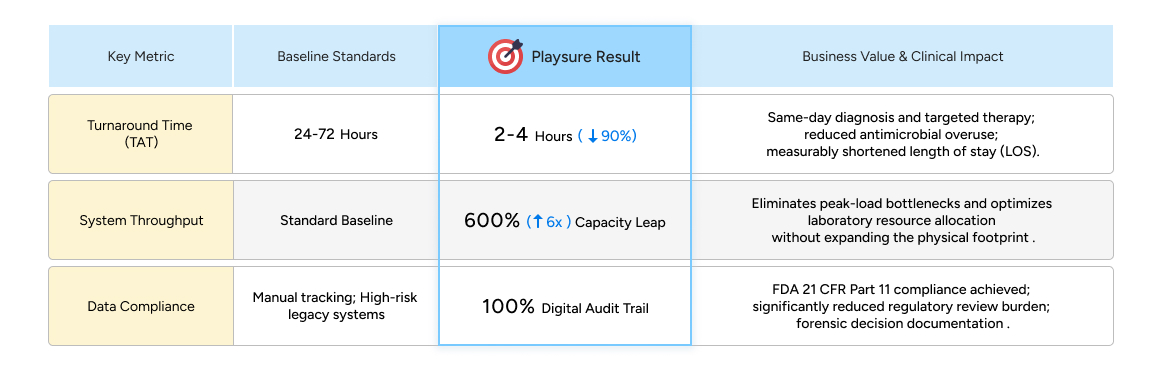
Through system re-engineering, Playsure translates technical benchmarks into tangible operational dividends, empowering our clinical partners at National Cheng Kung University (NCKU) and Chi Mei Medical Center to achieve performance leaps across three critical dimensions: time, throughput, and compliance.

Table Analysis: Key Metric, Baseline Standards, Playsure Result, Business Value & Clinical Impact Table Analysis: Key Metric, Baseline Standards, Playsure Result, Business Value & Clinical Impact
Key Metric Baseline Standards Playsure Result Business Value & Clinical Impact
Turnaround Time (TAT) 24-72 Hours 2-4 Hours (↓ 90%) Same-day diagnosis and targeted therapy; reduced antimicrobial overuse; measurably shortened length of stay (LOS).
System Throughput Standard Baseline 600% (↑ 6x) Capacity Leap Eliminates peak-load bottlenecks and optimizes laboratory resource allocation without expanding the physical footprint .
Data Compliance Manual tracking; High-risk legacy systems 100% Digital Audit Trail FDA 21 CFR Part 11 compliance achieved; significantly reduced regulatory review burden; forensic decision documentation .

Future Outlook

Establishing Digital Resilience in Global Healthcare Systems, starting from critical infection diagnostics

The strategic research collaboration led by National Cheng Kung University (NCKU) and Chi Mei Medical Center has established a pivotal paradigm for medical device modernization. By achieving a deep fusion of Algorithmic Engineering and System Architecture Re-engineering, Playsure is advancing the transition of academic innovation toward clinically applicable systems, laying the essential Digital Infrastructure for the broader precision medicine ecosystem.
This model operationalizes "Diagnostic Stewardship" at scale, empowering clinical decision-making to transcend traditional temporal and spatial constraints. Beyond optimizing individual patient outcomes, this transformation fortifies the systemic resilience of public health frameworks. As a benchmark for bridging the "Translational Divide" between laboratory science and clinical bedside application, Playsure is contributing to continued technological advancement in addressing the global Antimicrobial Resistance (AMR) challenge.